Showing posts with label Grub Street. Show all posts

Friday, August 23, 2013

The Chinchilla Rapper


The students in my Grub Street Teen Intensive Workshop class are awesome.  They got an assignment to use elements from my own personal history as story prompts, and this is what it has led to...

(The chinchilla's name is Hammy.  He refused to stay in the family business by becoming a coat, and instead followed his dream of being a rapper.  Cotton candy also has something to do with it.  Things get weird here at Grub Street...)

Oh, and here is a photo of the actual chinchilla I owned in college (her name was Kenga):


Monday, May 7, 2012

Small thoughts from #Muse2012

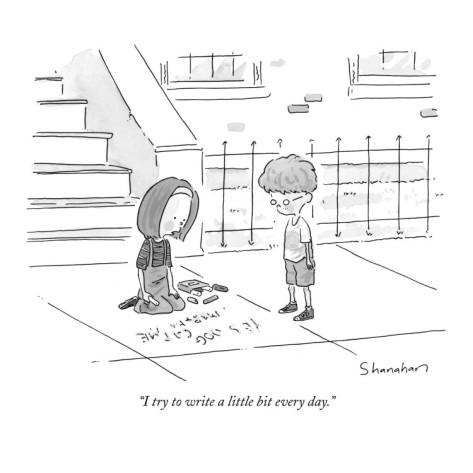
"I try to write a little bit every day."

This past weekend I attended the Grub Street Muse and the Marketplace writing conference.  I was delighted to catch up with old Grubbie friends, visiting professionals (some I'd spent time with earlier this year, some I hadn't seen in two years), and of course I took in some wonderful sessions covering both the craft of writing and the strategies of publishing.  Keynote speaker Julia Alvarez shared the above cartoon with us, as well as this quote...

She said she starts each day's work with the Mayan weaver’s prayer. She explained that Mayan weavers begin the day with whatever is on hand, whatever thread, whatever dye, and they know that each material may need to be handled differently in order for it to shine best within the final fabric, so there is no set design, nothing pre-planned about the arrangement of the weave when they sit down to the loom each day.  And so, before they begin work, they pray:

“Grant me the intelligence and the patience to find the true pattern.”

I'll share more from the Muse over the next several days, and may you find the true pattern of your writing when you next sit down to work.


Thursday, January 19, 2012

School's in.


As some of you may already know, I'm now an instructor at Grub Street, Boston's best literary gang. This winter I'm teaching a Teen Writing Camp section called "Generating New Writing" and there are SIX SPACES LEFT in the class! Tell all the Boston teens you know...

You can register for my class at the Grub Street website, and at the top of my blog you'll now see a "current writing courses" page that I will keep updated with course descriptions and appropriate links.

No apples needed. Just bring paper and pen.

Monday, November 14, 2011

Teen Writing Workshop, Winter Session


Starting at the end of January 2012, I'll be teaching a class for teens at Grub Street (otherwise known as Boston's Best Literary Gang)! The class will have no more than 12 students, aged 13-18, and there are some scholarship spots available...
This class is for teenaged writers who want to learn about and practice the art of "workshopping" one's writing. During this course, you will have the opportunity to “workshop” your poems and stories in class. We will discuss the strengths in your work as well as opportunities for revision. An inspiring and generative experience for young writers who are eager to develop their voice while helping others do the same. For writers age 13-18 ONLY.

SCHOLARSHIP OPPORTUNITIES: Grub Street is happy to be able to offer a limited number of full scholarships for this course. You are eligible for one of these scholarships if you are in a household that receives benefits from Massachusetts SNAP or Massachusetts TANF, if you are a foster child, and/or if your household’s gross income is within the free limits on the Federal Income Guidelines.

To apply for a scholarship, please send an email of no more than 500 words to chris@grubstreet.org describing why you want to take this class and stating that you meet the requirements above. At the end of the email, list the name and email address or phone number of one teacher or other non-relative adult whom we could contact for a recommendation. Please put "Winter Teen Scholarship" in the Subject line of the email. Deadline is 12:00pm on Friday, January 13th.
Register for my class here. I welcome fiction, narrative non-fiction (such as memoir), and poetry. I also welcome ALL GENRES -- literary, science fiction, mystery, romance, young adult, fantasy, horror, anything.

You bring the writing. I'll help you make it better, and I'll help you to help OTHERS to do the same.

Friday, September 23, 2011

Calling All Boston-Area Teens!


My beloved writing center Grub Street is offering two 6-week courses for teenagers, Generating New Writing and Workshopping Your Writing, that will run from 4-6pm on Friday afternoons starting October 14, 2011.

Grub is already home to the renowned Young Adult Writers Program (YAWP), and the new Teen Writing Camp programs are sure to be equally awesome. Generating New Writing is going to be taught by the inimitable and inspiring KL Pereira, and Workshopping Your Writing is going to be taught by, well...

Me.

Teen Writing Camp: Workshopping Your Writing

6 Fridays from 4:00-6:00pm at Grub Street headquarters. Begins October 14th.

This class is for teenaged writers who want to learn about and practice the art of ""workshopping"" one's writing. During this course, you will have the opportunity to “workshop” your poems and stories in class. We will discuss the strengths in your work as well as opportunities for revision. An inspiring and generative experience for young writers who are eager to develop their voice while helping others do the same. For writers age 13-18 ONLY.

Note: This class will not meet on Veteran's Day, 11/11, or the week of Thanksgiving, 11/25. The final class will take place on 12/2.

SCHOLARSHIP OPPORTUNITIES: Grub Street is happy to be able to offer a limited number of full scholarships for this course. You are eligible for one of these scholarships if you are in a household that receives benefits from Massachusetts SNAP or Massachusetts TANF, if you are a foster child, and/or if your household’s gross income is within the free limits on the Federal Income Guidelines.
To apply for a scholarship, please send an email of no more than 500 words to chris@grubstreet.org describing why you want to take this class and stating that you meet the requirements above. At the end of the email, list the name and email address or phone number of one teacher or other non-relative adult whom we could contact for a recommendation. Please put "Fall Teen Scholarship" in the Subject line of the email. Deadline is 12:00pm on Friday, September 30th.

You can register for any of the teen classes HERE. If you register for my course, know that all genres are welcome, as are novelists, short story writers, writers of narrative non-fiction (e.g. memoir), and poets.

I hope to see you there!

Thursday, July 7, 2011

Just bring a pen.


I've attended Grub Street classes for nearly two years. I've blogged about those classes in what my friends affectionately call my Grub Street "Cliffs Notes" series. And now, I am delighted and honored to be leading a free Grub Street workshop...

If you're in the Boston area, please come by. I'd love to see you, and I hope to be giving back a little of the inspiration that the other Grub Street instructors have consistently given me.

Friday, June 10, 2011

The writer is the one who stays in the room.

Photo by Javiy, found here.

With apologies for the appalling delay, here is my summary of my favorite lesson from the keynote speech by Ron Carlson at this year's Muse and The Marketplace writers' conference:

The writer is the one who stays in the room.

We are not writing to support our beliefs, we are writing to discover what might be worth believing in.

Writing is like walking out into the ocean. At some point, the waves will lift you up, and you won't be able to touch the ground. And it won't matter if the ground is six inches below you, or six feet below you, or sixty feet below. When you can't touch, you can't touch.

And there will be friends waiting for you on the shore, on the warm sand with towels to dry you off, and they will console you if you swim back to them, they'll say, "it's okay, we understand, you can try again to write tomorrow."

But it's your job to stay there, to deal with the ambiguity and uncertainty and fear.

Keep swimming.

The writer is the one who stays in the room.

Sunday, May 1, 2011

The Muse has spoken. Twice.


Today: a new flash fiction piece, CARETAKER, is up on my fiction blog.

This week: I talk about The Muse & The Marketplace 2011, Grub Street's tenth annual writers' conference, which is where I spent my weekend.

Monday, November 8, 2010

Meeting Chuck Palahniuk (redux)


The written content of this blog post first "aired" on May 3, 2010. I am reposting because I have had to link to the original post four times this week for various reasons, and honestly, the URL for that version is too long, and I'm sick of doing the bit.ly/ow.ly shortening thing. Plus, dammit, this was an AWESOME experience, and I will retell it as long as anyone is willing to listen. Sorry if it's a rerun for some of you. For the rest? ENJOY.

A little background: Chuck Palahniuk (pronounced with the same inflection and first syllable as pollinate: POL-ah-nik) was the keynote speaker at this year's Muse and the Marketplace literary conference hosted by Grub Street. I attended. We met. Fabulosity ensued.
___________________________________________________

I first saw Chuck signing a stack of his books in the conference's welcome area on the mezzanine of the hotel where the event was held, right around the time the first session of the day was starting.*

Even knowing Chuck's author photo, I would not have recognized him; indeed, I leaned forward to make absolutely sure that he was signing a copy of Pygmy before approaching him with my book. I'm sure others have said this before, but Chuck is unambiguously reminiscent of Anthony Perkins as Norman Bates. He is tall, skinny, clean-cut, tidily-dressed, and has an impressively gentle manner. In short, you don't see him coming.

I asked him to sign a copy of Fight Club for my husband. He asked me to tell him something embarrassing about my husband to work into the inscription: he tells a story, I tell a story, and the circle is complete... plus the book-as-gift has additional resonance.

I blanked. (Okay, I thought of one thing, but it was mean-embarrassing, not funny-embarrassing.) Chuck told me to take a minute. I did. I said that there was nothing I could say about my husband that didn't also incriminate me. He asked if my husband had any scars. He asked about vacations. I accepted these writer-prompts and began free-associating. And then we landed on something.

Chuck's eyebrows raised, and he asked for clarification. I gave it. Smiling, he signed the book, with detailed references, ending it with the single word, Dude!

Let me repeat: I managed to come up with something that raised Chuck Palahnuik's eyebrows. And that made him write an appreciative DUDE! in my husband's book.

And then, having thoroughly incriminated both myself and my husband, I collected the book, and asked someone to take our photo. The expression of laughter on Chuck's face is pretty much the one he had through my entire confession. I look good because I'm vaguely flushed with embarrassment instead of my usual shade of pasty white.**

(Sadly, that is as big as the photo gets, for inexplicable reasons only understood by my cell phone. It swears it took the photo at the largest resolution, and yet the image is practically thumbnail-sized. Sigh.)

His keynote speech was f---ing brilliant, go check out the video. At Q&A time, I asked What is on your bedside table right now? He thought for a while, laughed again, and answered, Are You There, God? It's Me, Margaret. Apparently he'll have a book coming out next year, called DAMNED, about an 11-year-old girl who wakes up in Hell, isn't quite sure why she's there, but is determined to make the most of it. (Side note: when Chuck talks to you, he looks at you. He didn't direct his answer to this question across the audience. He answered me. I am so doing this when I become a famous author.)

I eventually got a signature for myself on a copy of Haunted (since he'd gotten a 2-for-1 embarrassing story, I figured I ought to get a second book signed... my inscription is tame, and references the fact that I'm at this moment also trying to write a story set in Hell). He said he hoped I wouldn't get in trouble over the other book. I said that I was sure I would, and thanked him for his time.

Mr. Palahniuk, it was an absolute delight meeting you. ( And my husband's cool with you knowing.)

No, blog readers, you can't know what I told him, or what the rest of the inscription says. Sometimes, what you tell the author of Fight Club stays with the author of Fight Club.

Unless he decides to write about it. Oh, crap...


* First rule of literary conferences: consider going to some of your lecture-sessions late, or leaving some early. The awesome keynote speaker is not in the sessions. I know other people who had their best conference interactions in similar circumstances: going for a much-needed coffee at the same time as the dream editor, or sitting with a group of agents relaxing after all the pitch session attendees had scattered to their seminars.

** Let me clarify that (1) no one and nothing was harmed in the events described to Chuck Palahniuk, and (2) it was not "I would never do that again" embarrassing, it was "I would almost certainly do that again, but I don't usually tell people about it" embarrassing.

Tuesday, September 21, 2010

The Art of Anticipation


Before I say anything substantive about last night's Grub Street class, I would like to thank our instructor, Hallie Ephron, and my classmates for being so patient and kind with me... and with Serious Girl. I actually brought Serious Girl to class with me last night, because Husband was in South Dakota overnight, and I was unable to line up any of the babysitters SG trusts (it's not a long list).

So, from 7-9:30pm, SG sat on my coat in the corner of the classroom, eating dinner and watching The Backyardigans on the iPad. In this (intentionally) dark and low-res photo, you can see her holding one headphone to her ear, while holding her spoon with the other. There are two stuffed Backyardigans along the wall, and she's actually under a large easel. Class went until 10pm, but I decided not to push my luck or SG's bedtime any further and left at 9:30, taking the last writing assignment home with me.

Serious Girl, you were a nearly silent all evening, and you were a ROCK STAR. Hallie and my fellow students, thank you so much for giving us a chance and I hope we never disturbed your class experience.

So! Last night's class was called Writing Suspense. I am simply going to share some of Hallie's insights in bullet-point form:
  • Suspense is the potential that something bad is going to happen. When something bad actually happens, that's not suspense, that's conflict or action.

  • Suspense often involves taking ordinary objects and imbuing them with a sense of menace.

  • Suspense requires a clear sense of scene (time, place, etc.) because you cannot build suspense if the reader isn't grounded.

  • Suspense requires the laying of groundwork... if the reader doesn't have the critical information before the moments of tension, it's not suspense, it's surprise. As a writer, chances are you won't know what this critical information is until you've written the key scenes. That's what editing is for: go back and put that gun in the closet, that cell phone in the hospital room, that cliff near where the car chase will eventually happen.

  • Explanation ruins tension, which is another reason why the writer must provide any critical information and/or backstory before the suspenseful scenes, not during them.

  • Suspense can often be created by giving the reader information that the characters don't have (although some people can't read this kind of story at all).

  • The writer must raise the stakes so that characters will do things no normal person would. You know how you scream at the movie screen for characters in a horror flick not to go down to the basement? Make it so that the reader understands why the hero has no choice but to go into that basement.
Suspense and tension can be built through slowing the pace, creating a vivid sensory setting, putting the reader side-by-side with the character in peril (the "closeup" camera angle), juxtaposing the innocent with the unnerving, having the critical elements already established, and raising the stakes.

Suspense and tension can be eased by action, the anticipated bad thing actually happening (the payoff), something unexpected but harmless happening (the false payoff), humor, distancing the reader from the story (the "long shot" camera angle), summarizing or cutting away from the scene, or providing back story in the scene.

This class was a delight, and I'm picking up a copy of Hallie Ephron's Never Tell A Lie today. Hallie also authored Writing and Selling Your Mystery Novel, which a mystery-writing crit partner of mine recommends most highly.

Any suspense-writers here? What are your favorite techniques? Or, like me, do you just like the have the occasional moment of reader anticipation thrown in? What are your favorite suspense books?

Friday, September 17, 2010

You are NOT lazy.

Image found at the Visual Ambassador

On Sunday I took (yet another) Grub Street class, called "Time of Your Life." Taught by Hillary Rettig, the class focused on ways to find time to write for those of us who cannot give up our day jobs and/or are unwilling to sacrifice family, friends, and everything else in the name of our art.

Hillary spoke to us about living a conscious life: if you do not manage your time, someone else will be happy to manage it for you, and you'll end up working hard to fulfill someone else's dreams, not your own. She also spoke to us about PROCRASTINATION.

She spoke of the "laziness myth." Writers don't procrastinate because writing is "too hard." If it was really just too hard and we were lazy, well, we'd probably just give up trying to write altogether, and focus on watching t.v. instead. We could embrace the lazy lifestyle. But no, we want to write. We want to do this hard thing because it fulfills us and gives us joy in some way. We know that the work pays off with rewards. So then why do we put it off?

Fear.

It's not going to be as good as it is in my head. It's not going to be as good as that other author who writes in the same genre. The first 20 pages came out magically awesome, and the rest won't be as good. The first 20 pages came out kinda crappy, and surely the rest will be worse. I don't have the knowledge I need to write this well enough. I only have a few minutes, that's not enough time to write anything worthwhile... and suddenly we're doing the laundry instead of writing. Or doing more research when we probably have enough to get started. Or surfing the internet looking for a new blog that will give us the secret key to writing like James Joyce and getting published like Stephenie Meyers.

I don't have the answer to help you figure out which fear is yours, but I do know that this is a powerful message, and it should be passed along: YOU ARE NOT LAZY. Procrastination doesn't make you a bad person or bad writer... in fact, it's a pretty common-sense defense mechanism that protects you from feeling terrified of failing. But if you face the fear down? Then you can write anything you want.

Hillary has an ebook available for download on this subject as well: The Little Guide To Beating Procrastination, Perfectionism and Blocks (she told us that she no longer teaches the section on "hypersensitivity", but that the rest is still recommended material).

I've gotten some positive feedback on a project, and I'm scared of messing it up. But I have to edit, and have to finish, or I'll never get any further. And this project DESERVES to go all the way. HOW ABOUT YOU?

Thursday, September 16, 2010

Oh, thank goodness.

Finished First Draft Badge
from Merit Badger's badges for writers and readers


I finally finished my edits to a short story that I adore. In some ways it's a first draft, because it's the first version that didn't have actual story gaps in it. In other ways, it's almost a final draft, because I almost never write anything straight through. When I write longer pieces (more than 1K words), I pretty consistently end up at some point with a draft that is 85-95% complete, mostly revised and edited, but still missing some connecting scenes that would get the reader from Important Plot Point A to Important Plot Point B. This is apparently my style.

So, once these last scenes finally make it into the draft (in this case, saved Version #4), I'm actually, well, done. Those scenes are freshly written, but they've been mulled over for quite a while, and they're of a pretty reasonable quality to begin with. But I'm making sure to leave it alone for at least a few days just in case. I'll let it settle, try to forget about it, get beta readings from the two writers who were with me when the idea for this short story was inspired, and THEN do a final polish before submitting. And then I will have earned this badge:

The Finished Final Draft Badge.

I can't tell you how glad I am to have this done. This is the same short story I was telling you about when discussing methods of editing, and it's also the one that was inspired by my Monsters & Mayhem class at Grub Street back in Jan-Feb-March of this year. That's long enough to be working on a 7K-word story.

Seven thousand words! Most of my short stories are fewer than 1,500 words. Have I mentioned how thrilled I am to have this written?

PLEASE SHARE A RECENT WRITING ACCOMPLISHMENT THAT YOU'RE HAPPY ABOUT!

Tuesday, August 31, 2010

Editing Hits the Wall

One of my current WIPs

Many, many weeks ago, I took an excellent intensive course at Grub Street, entitled "From Revision to Submission."
Intended for the writer who needs a final push to submit their work, this class provides one last objective look to make certain that the writer is in the best possible position for publication. The first half of the class will be a revision workshop, focusing on the art of sanding down, smoothing out, and touching up the writing. The second half will help students discuss and find markets for their work. The last class will partially be devoted to assembling submissions and celebrating finished pieces.
The instructor was James Scott, who among other things is an editor at One Story, which is possibly the best lit mag out there right now, I think. The man knows his stuff, is what I'm saying here. He especially was a good instructor for me, because he has a natural instinct for plot and structure, where as I am more of a language-and-character writer, finding structure rather challenging.

So I am here today to share with you the single best piece of editing advice I got from the class: cut and paste, and stick it on the wall.

See that photo up there? That's a 20-page short story, which has been cut-and-pasted by scene (yes, actual scissors and tape, not computer-clicking) and spread out on the wall. I pasted certain scenes higher or lower based on the focus of each scene -- Character #1's POV was the baseline, omniscient narrator POV went slightly lower, Character #2's POV was taped slightly higher. Jim writes a lot of flashbacks, so he tends to tape sections higher or lower based on whether a scene is in the present or past. You may think of other ways to use the vertical as well as the horizontal.

Step back. Take a look. What do you see?

When I looked at the short story in that photo, I saw a lot of imbalance. Okay, it makes sense for that fourth scene to be super-short, because it's really just a teaser/introduction to the second character's POV, but the sixth scene is crazy long. Especially if the fifth scene is also that long... I want the narrator POV and 2nd character POV scenes to be places the reader can catch his or her breath in the story, and if scenes 5 and 6 are back-to-back enormous, that just won't happen. Scene 6 needs to be cut into at least 2 parts.

And look how front-loaded the story is! Scenes 3, 5, 6, and maybe 8 are the long ones, and then it's short-short-short all in a row at the end. No wonder the damn thing feels like it ends abruptly. Now, I already knew there were some plot elements that needed to be added to the story towards the back third, so some of those additions were already planned, but now it's even more obvious where this extra information has to go.

Depending on the nature of your story, you may also want to highlight sections. Is your dialogue evenly spaced throughout the story, or weirdly clumped in the center? Is your action where you thought it would be? Jim showed us one of his works-in-progress, and we saw that all the flashback was up front -- not good. The reader will want to know who everyone is and what the stakes are before they start dipping into reminiscences. How else will the reader know WHY those reflective moments are important?

Now, just because I'm talking in terms of balance of course does not mean that the story needs to be totally even throughout. Maybe the action really does belong all at the end. Maybe the story should start with all long sections and get increasingly tighter as the tale progresses. Only you know what your story needs, but this is a very good way to figure out what your story is already doing. They might not be the same thing, and sometimes it's just too hard to see the forest for the trees on the computer screen.

Jim swears that he's sold every story that has gotten this revision treatment. We'll see how my story fares when I'm done with it...

DO YOU HAVE A FAVORITE EDITING TECHNIQUE?

Tuesday, July 20, 2010

HIATUS: no more scheduled blogging


It's come down to this.

I know, I know, I suck. First I blogged every day. Then I cut back to 3x/week. And now I'm going all "whenever the mood strikes me and I have time" on you. I'm sorry.

But as much as I love my internet friends, I have a couple things that have to take priority: my family, and my fiction. Right now, given my schedule, there IS NOT ENOUGH TIME for blogging as well. (Or maybe there is, but I'm not quite good enough at what I do to make it all happen. You know how it is.)

I realize that blogging less may mean I lose some of my readers, but... well, I'd like to eventually be paid for my writing. You see my concern.

Thanks for understanding.

COMING UP WHENEVER I FIND THE DARN TIME:

One more blog post about Unruly Fiction.

Also, this week I am taking yet another intensive course at Grub Street, "From Revision to Submission" taught by James Scott. I've even taken a photo to go along with my first post for this course! Here's the summary:
Intended for the writer who needs a final push to submit their work, this class provides one last objective look to make certain that the writer is in the best possible position for publication. The first half of the class will be a revision workshop, focusing on the art of sanding down, smoothing out, and touching up the writing. The second half will help students discuss and find markets for their work. The last class will partially be devoted to assembling submissions and celebrating finished pieces.
I know, this is awesome, and I want to share it with you, but I have to actually revise my own work first. Hang in there.

Finally, on Friday I hope to post about What Form Rejection Means To Me for Le R's contest.

I'll be around as much as I can. Hang in there with me.

Friday, July 16, 2010

Oulipean Games Revealed! The surreal vs. the constrained


Once again, I am so sorry for my internet absence this week, in particular my failure to blog on Wednesday. I have had computer issues. The kind of issues that result in routinely getting pop-up messages that say "The data has failed to save and is lost." No data appears to have ACTUALLY been lost, but my ability to send emails and post comments/blog posts has been seriously restricted. Emergency back-up computers are now in use.

So! Oulipean games. Oulipo is an originally French movement, founded in 1960, the name of which derives from the full title: Ouvroir de littérature potentielle; roughly translated, "workshop of potential literature." More specifically, the Oulipo is a loose gathering of writers seeking to create works using constrained writing techniques: "the seeking of new structures and patterns which may be used by writers in any way they enjoy."

So, what EXACTLY does that all mean? Ultimately, it is a kind of rebellion against surrealism. While the surrealists saw rules as a damaging constraint, and dreams and irreality as the key to human potential, the Oulipo (many of whom were also mathematicians) went the opposite direction, believing that it was under constraints that potential can be most clearly realized.

Classic techniques of the Oulipo included:
  • LIPOGRAMS: writing with the absence of certain letters or sounds. Most famously, Georges Perec authored A Void (La Disparition), a 300-page novel that entirely excludes the letter E. (And then it was translated into a number of different languages, and all the TRANSLATORS managed to refrain from using the letter E... or, in the case of the Spanish translation, the letter A. I think that might even be more impressive, actually...)

  • UNIVOCALISM: text written with a single vowel (also can be described as a lipogram in all other vowels). Christian Bök wrote a novel that includes Chapters A, E, I, O, & U, in which each chapter has a coherent narrative using only one vowel.

  • TAUTOGRAMS: writing such that the first letter of each word (or at least every primary word in the text) starts with the same letter.

  • SNOWBALLS: in which the first word of the text has only one letter, the second two, and so on. (Also, "melting snowballs" in which the pattern is reversed and the text decreases down to a single letter.) Here's the one I did as an exercise in class today, using word lengths from one to eleven:

    I
    am
    she,
    ever
    aware,
    highly
    engaged,
    absolute.
    Endlessly
    anarchical.
    Captivating.

  • N + 7: a technique in which every non-proper noun is replaced with the seventh noun following it in a dictionary. Obviously, this requires both an original text and a dictionary to be chosen, and the depth and breadth of the dictionary will determine the results.

  • WORD LADDERS: a game in which a word is transformed into another by changing one of its letters at a time. Although the word ladders themselves may not have yet resulted in any works, the Oulipo speculated on the method as having inspirational potential, perhaps for the creation of a narrative using all the concepts in a given word ladder.

  • I did this in high school, actually. We would challenge each other with word combinations, and you had to get from on to the other in as few moves as possible. In rare instances, the addition or subtraction of a single letter was allowed. The trick was always moving the vowels to the right place... anyone care to write a short story based on one of my winning high school word ladders, moving from the word JUST to the word WHAT in the fewest possible steps?
    JUST
    LUST
    LOST
    COST
    COAT
    CHAT
    WHAT

    Although these are clearly extreme and occasionally ridiculous exercises, there are examples of actual narrative fiction for each of these. They say that necessity is the mother of invention: that you are more likely to use your creativity to design that which you desire in the absence of plenty. Shows like Top Chef thrive on constraints, challenging contestants to create magical dishes with limited menu items, specific inspirational guidelines, and rules about how (or for how long) one may cook any given dish. Why not writing?

    Indeed, as instructor Tim Horvath said, perhaps EVERY piece of writing is under some constraint (lack of time, need to meet a publishable word count, even the attempt to produce a narrative arc or a likeable character is a kind of constraint)...

    As someone who has only been published three times, each of which was under very specific language restraints (two pieces were Twitter-length fiction, required to be 140 characters or fewer, one was a "drabble" which must be precisely 100 words long), I may well be an Oulipian.

    DO YOU THRIVE TO PLAY WITHIN THE RULES, OR DO YOU CHAFE AGAINST THE RESTRAINTS? What do you make of the Oulipean Games?

    Christian Bök reads from "Chapter I" of Eunoia,
    a univocalist novel in vowel-specific chapters


    Click HERE if you're not seeing the embedded video.

    Tuesday, July 13, 2010

    Ceci N'est Pas Une Syllabus

    Click to enlarge.


    With this kind of classroom guidance, how can we fail to improve our writing?


    Have I mentioned how much I LOVE Grub Street classes, and Tim Horvath in particular? I'm having massive computer issues right now, but so far we've investigated
    • stories in other forms (such as lists, menus, indexes, and how-to articles);
    • the Q&A story (which may sometimes be missing the Q or A part); and
    • stream of consciousness
    I'll post more when I can.

    Monday, July 12, 2010

    School's In For Summer

    The original Grub Street

    Today's the first day of the first writing class (out of many) that I'm taking at Boston's Grub Street this summer. All this week I'll be taking Unruly Fictions with Tim Horvath:

    In this intensive version of the popular weekend seminar, we'll look in particular at works that have been dubbed "experimental," flagrantly challenging the conventions of narrative order and logic, cause and effect, plot and characterization, time and space. In several cases, they don't even look like stories. By trying out the exercises in this class, you will stretch yourself and explore some unconventional narrative modes. But this class is by no means geared exclusively toward those who already find themselves drawn to the literary avant-garde. The guiding assumption is that all writers can benefit from the ways in which such work galvanizes our minds and our pens, uncovering latent potential in whatever work we are already doing. By trying out everything from stream of consciousness to Oulipean games, montage to typology, you'll get fresh vantage points on your characters and storylines already in progress, whether in your mind or on the page.

    Yeah, I have no idea what half those words mean, either. But as the week progresses, I'll try to tell you what I can.

    WHAT ARE YOU WORKING ON RIGHT NOW?

    ETA: If you're here because you saw my article in the most recent print edition of the Grub Street Rag, welcome! That article was summarized from this post on The Muse and The Marketplace... I hope you'll read the original version, and stick around!

    Monday, June 7, 2010

    A hint of what's to come...

    Image from Kitsune Noir

    It's time to register for a new season of Grub Street classes! I know I haven't passed along much interesting stuff to you lately on that front, but that's just because the Ten Weeks, Ten Stories class really just doesn't lend itself to summarization: either you did the homework and got the in-class feedback, or you didn't, you know?

    In the summer, however, I will once again be taking some seminars, and those usually provide quite a lot of good material for blogging. I'll also be taking some week-long intensive courses, which I've never done before. Here's my upcoming class list:
    • Unruly Fictions with Tim Horvath

      Monday-Friday, July 12-16th

      In this intensive version of the popular weekend seminar, we'll look in particular at works that have been dubbed "experimental," flagrantly challenging the conventions of narrative order and logic, cause and effect, plot and characterization, time and space. In several cases, they don't even look like stories. By trying out the exercises in this class, you will stretch yourself and explore some unconventional narrative modes. But this class is by no means geared exclusively toward those who already find themselves drawn to the literary avant-garde. The guiding assumption is that all writers can benefit from the ways in which such work galvanizes our minds and our pens, uncovering latent potential in whatever work we are already doing. By trying out everything from stream of consciousness to Oulipean games, montage to typology, you'll get fresh vantage points on your characters and storylines already in progress, whether in your mind or on the page.

    • From Revision to Submission with James Scott

      Monday-Friday, July 19-23rd

      Intended for the writer who needs a final push to submit their work, this class provides one last objective look to make certain that the writer is in the best possible position for publication. The first half of the class will be a revision workshop, focusing on the art of sanding down, smoothing out, and touching up the writing. The second half will help students discuss and find markets for their work. The last class will partially be devoted to assembling submissions and celebrating finished pieces.

    • Funny is the New Deep with Steve Almond

      Tuesday, July 27th

      Contrary to popular belief, writing funny doesn't mean sacrificing depth. On the contrary, for most literary writers the comic impulse is inextricably linked to tragedy. In this informal class, we'll look at the work of Lorrie Moore, George Saunders, and others, in an effort to learn how you can be funny and break hearts while doing it.

    • Why Your Manuscript Was Rejected (also with Steve Almond)

      Tuesday, August 3rd

      If you're like most writers, you've gotten lots of rejections. Like, maybe even one earlier today. The big question in the mind of all of us is: WHY? Why didn't you take my brilliant prose? Is something WRONG with you? In fact, there is a reason your piece was rejected, and probably several. In this intensive and often incoherent seminar, Steve Almond (man of a million rejections) will provide a cogent summary of mistakes writers make, both in fiction and non-fiction prose. Among the topic's we'll cover: disorienting the reader, wandering plots, canned dialogue, and the ever-popular flowery prose. Taking this course virtually guarantees that you will NEVER BE REJECTED AGAIN. At least until such a time as you send out more work.

    • Crafting the Villain with KL Pereira

      Monday, August 23rd

      Some of the best and most memorable characters in literature are villains, rough and tough monsters, sly and sexy femme fatales, and naughty and deceitful oligarchs. They unnerve and excite us, sending a chill down our spines, and striking fear into our hearts. Yet when creating our own villains we often fail to overtly acknowledge the complexity and moral ambiguity that compels them to cause mayhem, delegating their motivation to a need to cause evil for evil’s sake and resulting in two-dimensional baddies. In this one-day seminar we will discuss traditional and non-traditional villains, why they are an essential part of any juicy tale, and how we can develop truly sinister and captivating characters that will antagonize, needle, and provoke even the bravest reader.
    ALSO! I will be out of town for two weeks at the end of June, but I will not be leaving you in the lurch! I am in the process of selecting some guest bloggers for you, and at least one of them will be hosting a BOOK GIVEAWAY CONTEST so you'll want to check that out for sure.

    Don't I sound organized? Now, where are all my socks...?

    What have you got planned for the summer?


    Tuesday, May 18, 2010

    Tuesday extra: Me 'n' Chuck

    Photo taken by awesome author Jennifer 8. Lee
    (who incidentally went to my high school)

    This was the second signature I got from Chuck Palahniuk at the Muse & the Marketplace literary conference, after the lunchtime keynote speech and Q&A session. To read about the first signature, see my May 3 blog post here: A minute of perfection was worth the effort.

    The video of Chuck's keynote speech is now available at the Grub Street website, or courtesy of Grub St. on Vimeo, or embedded below (if my html works). Watch it. Make your friends watch it. I promise that, unlike his notorious short story Guts, it will not make you pass out. I would be surprised, however, to hear that it didn't move you.

    There's about half an hour of speech, then the Q&A. At 33:00, you can hear him talk about being denied representation for his first novel (an 800-900 page "reeking waste of trees"). My question shows up at 40:58, and his answer lasts for nearly three minutes.

    (You can also see me in the audience at the very beginning when the camera pans around the audience. Yep. About 42 seconds in, at the second table from the podium, dead center, blue sweater and a ponytail. That's me.)

    So, it's long. It's also worth it. You don't even have to have read his books. Bookmark it, come back later to watch when you have time. At least the speech itself, if not the Q&A after.

    Please. You won't regret it.


    Wednesday, May 5, 2010

    Muse and the Marketplace


    THINGS I LEARNED at the Grub Street literary conference last weekend:
    1. Writers, as a whole, are not the snappiest dressers. We try. But most of us fall a bit short. (Surely there must be equally-comfortable-yet-less-ugly shoes out there for us.) It's okay, though, because we ooze enthusiasm and intellectual curiosity.
    2. I will need to pay for a VIP table or pitch session next year if I want to chat with agents or editors. I just don't have enough chutzpah to randomly approach people with the "special guest" badges and start chatting them up. I didn't even really want to pitch any of these people, but I would have liked to ask a few questions about genre trends and the market, and I didn't see a single agent or editor all weekend unless they were on a panel.
    INSPIRING WRITERS I MET other than Chuck Palahniuk:
    1. Thomas Mallon, who spoke about "Faking the Real": basing fictional characters on real people. (Turns out he taught English at my college for 12 years, but left the year I got there. Argh!) He argued that every novel is a roman à clef, because all characters are composites, refractions, or appropriations of the people we meet in real life. He also said that there tend to be very few situations in which we need be concerned with the legal repercussions of using real people in our work, and instead we should consider the moral implications (who might be hurt) on a case-by-case basis.
    2. Pablo Medina (faculty bio above, poetry & an interview linked here), who talked about WILDNESS in fiction. My husband tried to get me to articulate what I found so inspiring and affecting about this lecture, and I was at a bit of a loss. He spoke about writing like dancing: too little form, and you're stepping on your partner's feet, bouncing off the walls and ceiling -- too much form, and you approach the machine. The key is to keep the wildness without losing the structure of the dance. He said that the only story worth writing is the necessary one, where the demonic impulse of the writer can be transformed into a sense of urgency in the reader. He said that the word perfect comes from the Latin perfectus, meaning finished, and that only dead things are truly finished. Hence, there is no perfection in writing, there is only the pursuit of literature. I've been struggling to make my writing less "safe", so this all resonated very deeply with me. (Also, Pablo has the stage presence of Mikhail Baryshnikov mixed with Anthony Hopkins, only Cuban. It works. Just sayin'.)
    THINGS I LEARNED ABOUT WRITING from a panel of contest judges:
    1. Make your story bigger than the narrator
    2. Make the reader fall in love on the first page
    3. It's a bad sign if your reader starts checking what page number they're on ("how much more do I have to read?") or has to check the flyleaf of the novel to remind him/herself what the story is about
    4. The story should have passionate urgency
    5. Things need to happen ("...even if it's just the protagonist standing up in that café and saying I'M BORED AND FILLED WITH EXISTENTIAL ENNUI, then at least he'd be moving and talking...")
    6. The story should have ease of writing: let the reader become so engrossed that s/he forgets the language
    7. The story should have elements of surprise instead of telling the readers all the things they could just as easily assume/infer
    8. "Just cut out the boring bits"
    9. Humor is good
    10. Emotional resonance is great
    11. The judges on the panel vastly preferred contests where pages are submitted anonymously
    12. The judges on the panel said their job was not to figure out "what do I like" but rather "how well did the writer accomplish what s/he set out to do?"
    13. Don't resubmit the same work to the same judges for the same prize
    14. Contest entries are down this year, perhaps because of the economy
    15. It's better to apply to contests with more than one award (you have a better shot at winning something if there are 2nd and 3rd places, honorable mentions, etc.)
    CONCLUSION: It was a blast, and I will absolutely return next year, and I may look into attending other conferences hosted by other groups.

    Have you been to a writing conference? What were the best parts? What did you learn there?