
Showing posts with label On being a writer. Show all posts
Showing posts with label On being a writer. Show all posts
Wednesday, June 20, 2012

Monday, May 7, 2012
Small thoughts from #Muse2012
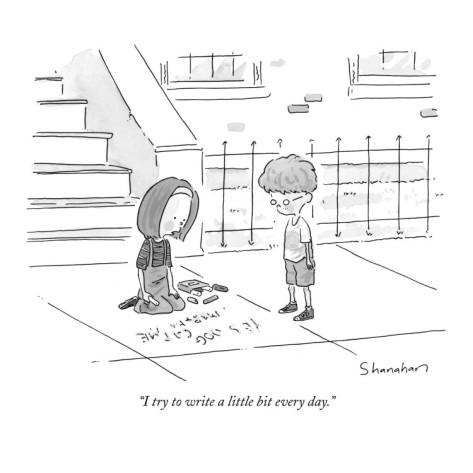
"I try to write a little bit every day."
This past weekend I attended the Grub Street Muse and the Marketplace writing conference. I was delighted to catch up with old Grubbie friends, visiting professionals (some I'd spent time with earlier this year, some I hadn't seen in two years), and of course I took in some wonderful sessions covering both the craft of writing and the strategies of publishing. Keynote speaker Julia Alvarez shared the above cartoon with us, as well as this quote...
She said she starts each day's work with the Mayan weaver’s prayer. She explained that Mayan weavers begin the day with whatever is on hand, whatever thread, whatever dye, and they know that each material may need to be handled differently in order for it to shine best within the final fabric, so there is no set design, nothing pre-planned about the arrangement of the weave when they sit down to the loom each day. And so, before they begin work, they pray:
“Grant me the intelligence and the patience to find the true pattern.”
I'll share more from the Muse over the next several days, and may you find the true pattern of your writing when you next sit down to work.
She said she starts each day's work with the Mayan weaver’s prayer. She explained that Mayan weavers begin the day with whatever is on hand, whatever thread, whatever dye, and they know that each material may need to be handled differently in order for it to shine best within the final fabric, so there is no set design, nothing pre-planned about the arrangement of the weave when they sit down to the loom each day. And so, before they begin work, they pray:
“Grant me the intelligence and the patience to find the true pattern.”
I'll share more from the Muse over the next several days, and may you find the true pattern of your writing when you next sit down to work.
Thursday, April 19, 2012

Thursday, January 12, 2012
Permission to write: Thou Mayest

Image found at Archaeolibris
My good friend and ruthless crit partner Bernice Buresh just sent me an email from California that I feel compelled to share here:
We stopped at the John Steinbeck museum in Salinas... Glad we did. In one display, there was a carved wooden box and a copy of East of Eden. This is what the description said:
When Steinbeck was writing East of Eden, he began each day's work by writing a letter to his editor Pascal Covicí. He made a box with the Hebrew word Timshel carved on it. It means Thou Mayest. When Steinbeck finished the book he sent the manuscript in the box to Covicí.
This is how I interpret this. Steinbeck needed a daily check-in, so he created one. Steinbeck needed permission to do this project. Since the story was about Cain and Abel he found an old testament word that he could use as a talisman to give him permission.Conclusion: Steinbeck needed the same things we do to do his work.
An excerpt from those letters to Steinbeck's editor (which filled a journal over the better part of 1951) confirms Bernice's hunch:
I must get into the book again at least try to even though my mind is badly cut up in all directions. Very hard to concentrate today. But I must try for my own safety.Take things in stride and particularly don't anticipate trouble before it happens. One of my very worst habits is the anticipation of difficulties and vicariously to go through them in advance. Then, if they do happen I have to do it twice, and if they don't happen I have done them unnecessarily. I know this is my habit... but not to do it requires constant watchfulness on my part. I have the recurring tendency. I guess I am what is called a worrier.
In my first blog post of the new year, blood on the page, I wrote that you don't need permission from ANYONE to write, and that in seeking permission, approval, or encouragement from outside sources, you may be giving away power you should keep for yourself. Great writers aren't immune to self-doubt, fear, or writerly obsessions -- I read somewhere that Hemingway's manuscripts were found with numbers written in the margins that turned out to be tallies of his daily word count -- but perhaps these writers were able to give themselves the permissions and structures they needed to defeat those doubts long enough to get the damn work done.
Timshel. Thou mayest. If you choose, go write. No one else can move those mountains for you.
How do you give yourself permission to write?
Tuesday, January 3, 2012
Blood on the page.

I think this is important. Sit down. I want to take my time with this.
Remember these classic writing quotes?
Writing is easy: All you do is sit staring at a blank sheet of paper until drops of blood form on your forehead.~ Gene Fowler
There’s nothing to writing. All you do is sit down at a typewriter and open a vein.
~ Walter Wellesley “Red” Smith
I'm starting to believe that these quotes are being widely and wildly misunderstood. I'm starting to think that some people think the meaning behind these quotes is, "Writing is easy, if only you give enough of yourself, you special creative creature, you." Art is suffering, isn't it all so terribly romantic, let us melt together, we unique snowflakes.
Unfortunately, I am also of the firm belief that these writers meant the exact opposite. Don't get lost in the clever language, it's actually just self-deprecating sarcasm. What they are really saying is, "I have to sit in front of this blank page to write, and it's hard for me, even though I know it's a lot easier than a million other jobs out there." And, "I have to be brutally honest when I write, and it's hard for me, even though I know it's a lot easier than a million other jobs out there."
A really good book is a thing of beauty. A book that resonates with you can change your whole world. Even a lousy book can be a lot of fun. But being a writer? It can be a thing of beauty, it can be special and magic... but it's also a job. Just a job. You have to be professional and do the work.
Let's be clear. Being professional and doing the work is hard. And not everyone is talented enough or lucky enough or persistent enough (or the-appropriate-yet-variable-combination-of-all-three enough) to "do the work" well enough to succeed on the scale to which they aspire. Just like not every high school student gets into the college of his or her choice, just like not every lawyer made law review, just like not every talented-and-persistent-and-professional person is employed right now.
But I personally think this is rather liberating -- There's nothing inherently special about writers and artists unless you do the work and do it on time and do it well.
The good parts of a book may be only something a writer is lucky enough to overhear or it may be the wreck of his whole damn life and one is as good as the other.~ Ernest Hemingway
Maybe you suffer. Maybe you get lucky. But know that you're not a better or more important writer if you bleed. Maybe it seems more romantic and sexy to be emotionally wrung out by the power of your own words, to wait for the magic moments of inspiration, to be a fragile artistic flower in need of just the right sunlight and water.
But some writers -- some very good writers -- just have fun. This year, I choose to skip the drama. I choose to be healthy and productive. I choose to make my own sun and water instead of waiting for it to arrive from some mysterious outside place.
Do the work. Get it on paper. Be professional. That's all.
Here are the real secrets:
- You don't need permission from anyone else to write. In fact, you should be really, really careful about how and from whom you seek permission and encouragement. It's giving away power that you should be keeping for yourself.
- Similarly, you are the only one in the world who can kill your dream. Insecurity, lack of discipline, fear of failure, lack of professionalism, impatience... that's up to you to overcome. It's not up to anyone else, no matter what they say. Getting the approval of an agent / editor / family member / literary critic / published author / mentor won't be the thing that makes you better. And thank god for that, because it also means that it doesn't make you worse when the approval of those people isn't forthcoming.
- Words are like blood in one way: you can make more.
Writing is hard. So is every other job that uses your brain. Don't be romantic about it. Be determined. If it's what you want to do, sit down and write. And when it gets hard? Remember that you chose this. And unless you want to quit, it's up to you to choose it again and again and again until the job is done.
Otherwise, there are a million other jobs out there...
Monday, April 18, 2011
Audience

As I approach my 300th post, a few thoughts about blogging are rattling around in my head on the subject of readership. I imagine that most writer-bloggers ponder these at some point, and now it's my turn. Who, exactly, is my audience? Are the people who read my blog actually going to be interested in my novel once it is published? Are the people who buy my book once it is published actually going to want to read my blog as well? Does it matter?
With non-fiction, it's a more obvious connection. Those authors have special and specific knowledge about a particular subject that can be the basis of their readership across a variety of platforms. Someone who writes about science can also blog and tweet about science, and the same demographic applies. It's all non-fiction.
But the non-fiction "voice" of an author is not the same as the fiction "voice" of a novel's narrator. Sure, a writer of comic novels may want to cultivate a comic tone in her blog, and a writer of middle-grade books will probably want to keep his blog PG-rated so that there is some overlap between the stories and the writer's online presence. But ultimately, the things I want to talk about may not have any appeal to my future readers, and vice versa. (Jody Hedlund covered these issues quite nicely in a blog post she wrote earlier this year.)
If I write about my path to publication, I'll naturally be attracting mostly other writers. Now, other fiction writers should obviously also be fiction readers*, but who knows if they read the kind of fiction I write. Will the fiction posts get lost in the shuffle of "regular" blog posts, making it too hard to find for the readers who do want it? Might putting my fiction on my blog (as I did here and here and sort of here) actually be confusing and unwanted for my regular blog readership? Because as much as I want people to read (and eventually buy) my fiction, I like blogging. I hope that my posts on the craft of writing have been genuinely helpful to people. I hope that people can save time when looking for their first agent because of resources I've provided.
I've decided that one blog cannot be all things to all people. So I've created a second, fiction-only blog. People who want to read my short stories can go there. People who want to hear my personal, struggling-writer's voice can stay here. I hope a lot of you fall into both categories, but it's cool if you don't.
Readers, WHAT DO YOU WANT MORE OF IN THIS BLOG? What have been your favorite posts so far? Tell me a little bit more about yourselves, so I know who my audience really is.
*If you're one of those people who thinks you can write a novel without reading extensively... you're wrong. Go watch So You Want To Write a Novel and then for the love of all that is holy go get a library card and start doing your homework.
Tuesday, March 29, 2011
Binge Thinking

I've never liked multi-tasking. I much prefer to focus on a single job, get it done, and then move on to the next project. Now this obviously isn't a practical way to function most of the time. When I was an attorney, I never had just one client or conveniently had assignments that were due one after another with plenty of space to work in between. And if I don't try to work on dinner at least a little bit before my day's work is done and Serious Girl and I come home from her after-school classes at 5:45pm... well, then there's nothing to eat. So I have to multi-task sometimes. Okay, a lot. But I don't have to like it. And it's not how I work best.
I mentioned in an earlier post that I am a binge listener: I don't listen to full "soundtracks" when writing, instead I'll listen to a single song on repeat for hours and hours. It turns out that this narrow-focused mentality creeps into my behavior everywhere. When I'm writing well, I'll do nothing else for a month. But also when I blog, I just blog. When I was on Twitter, I did just that. I have to recognize my limitations.
I've been off the grid for a while now. It's working for me. I'm glad I got online and met so many cool writers, learned from people who had queried and submitted before me, and got so much support. But I can't be on social networks and write at my full capacity. Others can. Not me.
So for now, I'm writing. Just writing. But the blog isn't going dark. The blog is called Heim Binas FICTION, after all... I'm going to start posting some of my short fiction. At least a story a month, maybe more. That way, my blog will be working for my obsessive nature, not against it. And maybe y'all will actually like my stories. I'd really like it if more people were reading what I'm writing. So until the publication gods smile on me... I'll be posting here.
And here's the song I'm currently listening to on endless repeat: So What by Space Mtn.
Tuesday, March 9, 2010
Sworn enemies are good for you

Did you all know that, in Greek mythology, Nemesis was a remorseless goddess who meted out divine and vengeful retribution upon those who succumbed to hubris? (Or, as my dear friend Al would say, upon those who "committed hubricide.")
Now, of course, nemesis means one's sworn enemy: "normally someone or something that is the exact opposite of oneself but is also somehow similar." (thank you for that choice phrasing, Wikipedia).
As my blog readers probably know -- and as my Twitter followers definitely know -- I now have a literary nemesis. So why do I like the idea of having a literary nemesis in the first place? Betsy Lerner recently blogged about the bête noire, but the nemesis concept as I see it is not merely about having a single target onto whom we can focus our creative envies. (Although I see the point of that as well. I have a legal bête noire, and that certainly helps me vent those career frustrations once in a while.)
My nemesis concept is about the next generation of writers. Look around, fellow author-bloggers. We're it. Some of us will be the hotshots, some will be the midlists, some will struggle, but we are in it.We're building a community, we're critiquing each other, we're commiserating together... and we're going to challenge each other as well. Sometimes we're going to compete. Sometimes we're going to get the short end of the publishing stick. We're going to have to keep it together through all that if we're taking the vocation seriously.
So, a nemesis is a partner-in-crime. Someone who will push you because his writing is so dang good that it drives you a little crazy (because deep in your writer's heart you secretly believe that he probably didn't have to edit at all, that his stories just sprang from his head fully-formed like Athena) and there it is, you have something specific to strive for, and then you banter a little online and oh joy it turns out you have a similar sense of humor, and if we make each other laugh then that must mean that if I work hard and edit well, then one day he'll be just a little bit jealous of something I wrote (and what a compliment that would be) because we sometimes think the same way and we both kind of get it, and because we're all insecure and crazy in this together anyway, but someday some of us are going to be somebodies and so we should all make friends now because if we get isolated and jealous for real it will just eat us up when we should be having fun and writing, dammit, and if you're not laughing along the way, then it's really not worth doing and yes, you're meant to read this as though it was all one breath.
So bring it. And pick someone who is "somehow similar" who will bring it right back.
Wednesday, February 10, 2010
Monsters and Mayhem, Part 3 of 6

And now we return you to your regularly scheduled programming, already in progress:
As my regular readers know, I'm taking a 6-week course called Monsters and Mayhem at Grub Street, taught most evenings by Sue Williams and KL Pereira. (New link for KL! Blog this time! Check it out!)
Sophie Powell was last night's guest instructor, and week three was all about world building and backstory.
You classics and history buffs will appreciate the fact that Sophie started by having us read excerpts from The Odyssey, specifically those passages describing the physical environments inhabited by the Cyclopes and Circe. The arrogant and giant one-eyed monsters lived on untended land where they needed to do no work because the Gods provided everything for them. The more seductive goddess-witch Circe, by contrast, lived in an enticing house with high-backed chairs, polished tables, and girls to help bathe and feed Odysseus. As Homer did, so you too should consider physical setting: how does your monster/character's home and local environment reflect or contribute to its personality? If you are writing anything other than contemporary realism (speculative fiction, magical realism, even historical fiction), how does the setting of your story contrast with the world as we now know it? How does that affect the players in that world?
We also pondered several questions relating to our characters' backstories:
- Have they always been monsters/villians?
- Have they always been unloved/loved?
- What do they really want from life? How would they choose to die?
- Who or what do they care for? What is their most treasured possession?
- Do they like their appearance? What are their favorite/least favorite body parts?
- Are they creatures of habit?
- Do they sleep lying down? What do they dream about?
- What do they worry about? Get excited about?
- What do they fear? What do they love?
- What do they have faith in? Do they believe in a higher power?
It is truly amazing how many answers there are to these questions. One character might want to die in battle... another surrounded by loved ones... and yet another might want to die alone, away from prying eyes. And I found many of the questions especially interesting because in the story I'm working on, the main character is dead. So, in order to write this well, I should know exactly how she died, and whether it was what she wanted. I should know if the afterlife is what she expected. I should know if there's any possession she misses from her time on Earth.
Good stuff.
If you like where these questions are taking you, you should check out the Close Your Eyes post on KL's new blog, where she will lead you on a character-discovery visualization similar to the one Sue did for us during the first class. While the exercise is geared towards the fantastical, it might very well work for any character you're writing about.
PLEASE TELL US A TIDBIT FROM YOUR CHARACTER'S UNIQUE WORLD OR BACKSTORY. I think this stuff is just fascinating...
Thursday, February 4, 2010
Are you sexy enough for literature?
 poster from Cafe Press
Yesterday's Dystel & Goderich blog post talked about the phenomenon of authors as rock stars. The blog linked to an article about the rock-star-ness of Joshua Ferris, and ended with the question, "Does an author’s looks or celebrity status influence your decision to buy his/her books?"
I was all set to scoff. Choosing a novel because the author is hot? That's probably the last thing I think about, running way behind the pack of more important reasons like: who recommended it, if I liked the author's work before, the back-of-book plot summary, cover art, availability in my format of choice (trade paperback), publishing house, and typography. Sure, we joke about it, but no one who actually cares about literature would care about an author's looks, because writing ability and appearance are wholly and utterly unrelated.
Yup, I was all set to comment, and then I remembered my post on John Irving. Into which I inserted no fewer than six author photos. Damn. What can I say, I have a total reader-crush on the guy.
Okay, I stand by my belief that I would NEVER EVER buy a book just because the author was good-looking. I mean, jeez, that's what the internet is for: free photos of people we like to look at. But there's definitely something enjoyable about reading a work of genius and then discovering that the person who wrote those words is visually appealing as well. Whether it's an expression like they've got a secret (Irving), a certain scruffy-headed charm (Neil Gaiman), killer eyes (Zadie Smith), or a wicked smile (David and Amy Sedaris), it IS nice if we like to look at those who we like to read.
But is there too much pressure for writers to have an intriguing (sexy) image? Take a quick look at this blog post: Can we stop being sexy? Just for five minutes? to compare one author's book jacket photo with a more casual photo. I personally think that the intent behind the "sexy" photo may have been to make the author look more intense and thoughtful (writerly) rather than give her a come-hither expression... after all, the title of her book was Special Topics in Calamity Physics, and I imagine that the marketing people decided that a certain formal glamour fit the book's packaging best. But the result was more or less the same: the photo made her look ethereal, and like a deep thinker, AND sexy. (But can we blame the author at all? Who wouldn't want to look amazing in a publicity shot?)
So. Any writers you love to look at? Any thoughts on the presentation of authors as a visual commodity? And, what's going on YOUR book jacket?
I was all set to scoff. Choosing a novel because the author is hot? That's probably the last thing I think about, running way behind the pack of more important reasons like: who recommended it, if I liked the author's work before, the back-of-book plot summary, cover art, availability in my format of choice (trade paperback), publishing house, and typography. Sure, we joke about it, but no one who actually cares about literature would care about an author's looks, because writing ability and appearance are wholly and utterly unrelated.
Yup, I was all set to comment, and then I remembered my post on John Irving. Into which I inserted no fewer than six author photos. Damn. What can I say, I have a total reader-crush on the guy.
Okay, I stand by my belief that I would NEVER EVER buy a book just because the author was good-looking. I mean, jeez, that's what the internet is for: free photos of people we like to look at. But there's definitely something enjoyable about reading a work of genius and then discovering that the person who wrote those words is visually appealing as well. Whether it's an expression like they've got a secret (Irving), a certain scruffy-headed charm (Neil Gaiman), killer eyes (Zadie Smith), or a wicked smile (David and Amy Sedaris), it IS nice if we like to look at those who we like to read.
But is there too much pressure for writers to have an intriguing (sexy) image? Take a quick look at this blog post: Can we stop being sexy? Just for five minutes? to compare one author's book jacket photo with a more casual photo. I personally think that the intent behind the "sexy" photo may have been to make the author look more intense and thoughtful (writerly) rather than give her a come-hither expression... after all, the title of her book was Special Topics in Calamity Physics, and I imagine that the marketing people decided that a certain formal glamour fit the book's packaging best. But the result was more or less the same: the photo made her look ethereal, and like a deep thinker, AND sexy. (But can we blame the author at all? Who wouldn't want to look amazing in a publicity shot?)
So. Any writers you love to look at? Any thoughts on the presentation of authors as a visual commodity? And, what's going on YOUR book jacket?
Wednesday, January 20, 2010
Shiny Tiara Power

Yep. That's a tiara on my head. Wanna make something of it?
Mur Lafferty rocks my world.
Seriously, if you want to write fiction, and you're not listening to Mur's I Should Be Writing podcast, then I'm just convinced you're not really trying. It's like the best blog ever, but in audio format, and with published-author interviews.
Anyway, Mur recently wrote a blog post about Sour Grapes and Spite in which she was brutally honest about the bitterness and resentment some of us feel when others get what we want. Because it's not always abstract. Sometimes it's not just that you think that "others" who can't write as well as you are making the big bucks while you toil away in impoverished obscurity... sometimes someone else gets the job or the grant or gets to write the exact article you were trying to score for yourself. You strive to be the best you that you can be, and you do your research and write your cover letters and design your proposal and write your butt off and do everything you could have done... and someone else gets it anyway.
Let us take a moment to mourn and rage against the competitors.
(And maybe you, personally, don't ever feel this way... in which case you must be really Zen, or really in touch with your higher power, or just really really a better person than I am, but if you're not one of those totally unbelievably generous and kind people, you'll know what I'm talking about. The rest of you can go away and have a cupcake because you clearly deserve it and you don't need to waste time reading about petty jealousies because you're above that. Kudos.)
Now, after you've mourned and raged (and, if you're me, gotten your husband to trash-talk that person for you while you eat ice cream)... WHAT DO YOU DO NEXT?
I am prepared to forgive repeated lapses into unlovely thoughts about those who get what we feel is "rightfully" ours, but after a while wallowing ceases to be therapeutic and actually stunts progress. And that's a problem.
In her post, Mur wondered why she didn't just go out and do the things she wanted to do, despite not getting that position/grant money. Why not just go do it anyway? Naturally it would have been easier to do all the things she wanted if she had funding and a fancy title, but, as she put it:
I don’t need the label to do the work, and if I honestly thought I could help people out, then why did I need the shiny tiara power of the position to do so?
(You were wondering what was up with the tiara. Now you know.)
So, I am hereby distributing Shiny Tiara Power to those who need it. Maybe you don't have the imprimatur that you would have gotten by virtue of getting the job / the grant / the article / publication. But I bet there's something you can do in that same direction without any official sanction. Go put on your tiara. Go do it.
I don't know if I'll ever be able to be totally let go of that nugget of spitefulness I've been known to harbor... but maybe I can roll it up in a nice productive/competitive outer shell. Maybe I can make sure that it always drives me forward rather than stopping me cold.
Also, I should probably learn to blowdry my hair and put on some makeup before I post photos of myself online, but whatever.
Tuesday, July 28, 2009
Balancing Act: Work Edition

Okay, Amy gets first pick because she posted in the comments first! (Although I'm happy to say that it sounds like more than one person is interested in her chosen topic.) This post is about balancing writing with the day job.
I'm an attorney. Big Firm lawyers are not known for having a whole lot of extra time on their hands, but I am here to tell you that time can be made to write if it's important to you. (If it's not that important to you, then by all means go see what's on your TiVo instead.)
When did I start to make time for my writing? In 2005, when I learned about NaNoWriMo: National Novel Writing Month.
The challenge: Write a novel (defined as 50,000 words or more) within one month. Specifically, the month of November. Even more specifically, the month that started about two weeks from when I found out about NaNo. This was ideal. It was definitely a benefit to not have too much time to consider what I was getting into, since I hadn't been writing regularly up to that point. More about "irregular" writing towards the end of this post.
The goal: The end of the "some day" novelist. If not now, when? I loved writing -- writing is my favorite part of my legal work as well -- and I wrote fiction intermittently, and even though I had never said out loud that I wanted to write a novel someday, the second I heard about NaNo, I knew that I had to do it. You wanna write fiction? Then put up or shut up.
The reason it works: Successful NaNo writers are so focused on the time constraints that the internal naysayers ("...it'll never be good enough...") have no choice but to shut up and get out of the way. How good can it be in 30 days, anyway? The point is to get the sheer volume of words down on paper. Don't get it right, get it written. You can't edit a blank page.
The result: Dude. It was awesome.
It is worth mentioning that I did not win. Let me be clear on this -- for me, NaNo was and will probably never be about "winning" in the strictest sense: 50K words in 30 days. My natural writing style apparently tops out at around 1,000 words in a day, and you need nearly twice that to win NaNo (especially since there will probably be at least a day or two where you don't write at all). It's not just that I lose quality when I try to write more than 1,000 words a day, it's that it's not fun for me anymore. And I actually lose the thread of the story by trying to pack something (anything!) into the story just to meet a high word count goal. I need more "down time" for ideas to percolate.
But I absolutely won in the grander scheme of things. In November 2005, I wrote 30,000 words that would not have been written otherwise. And because of the ridiculous time crunch, I abandoned all thoughts of getting a "perfect" writing environment, or a "long enough" span of uninterrupted time.
Admit it, writers, don't you think this? If only I didn't have to work so late, I'd have the whole evening ahead of me. If only I could write somewhere isolated where I could play my music. The if onlys will kill your productivity dead. You must squelch them quickly and ruthlessly. THIS IS THE TIME MANAGEMENT LESSON LEARNED FROM NaNo. It's not just about dumping the idea of perfection in your actual writing (it's called a "first draft" for a reason, people). It's also about dumping your ideas of having the perfect writing environment.
I was working full time at a law firm during my first NaNo, and I wrote during the down times when I was waiting for a senior partner to bring me his edits. (Before NaNo, I probably would have idly surfed the net instead, and then wondered what happened to my one evening break.) I carried a spiral notebook with me everywhere, writing in bed before I fell asleep, and in the morning right when I woke up. When I had a moment alone with my computer but no ideas, I would transcribe those handwritten notes, and often found that the new ideas would bubble up while the old ones were being typed out.
And it wasn't about inspiration. This is also important. I wrote "irregularly" before NaNo, because I basically waited to be inspired. When I was hit with an idea, I would write it (and I think I wrote it well), but in between those times... nothing. What NaNo taught me was how to work despite a lack of inspiration. It taught me how to problem-solve... I mean, something has to happen next, right? And there's a deadline, so I can't just wait a few weeks for the idea to show up on its own. So instead of waiting for that magical bolt of idea-lightning, I would consider all the things that could happen. And the more I did it, the more I would recognize when one scenario was the right one for the story.
And that's how I ended up with 30K words in 30 days despite having never written anything that long before. And I felt like I had more time in my days because I was using the time well.
Bear with me for an analogy: Weight Watchers assigns points to all foods, so you can "budget" what you eat, given the number of points you should eat every week to stay on track. Normally, if you tell me I can't have something, I immediately want it. (Very mature, I realize.) So, when I first joined Weight Watchers, I immediately did the math for one of my junk food favorites, and realized that a single Big Mac (I used to have two in one sitting, oh, how I miss my teenage metabolism!) would use up 80% of the base number of points I had in any given day, although there were extra weekly points I could use up to "pay" for that meal. And boom, like that, I wanted a Big Mac, because it was horrible for me and I "couldn't" have it.
Except, the whole point of WW is that you can have whatever you want, as long as you budget your points properly. So, if I was committed to making it happen, I could have eaten lots of zero-point foods that day to balance out the Big Mac. But every time I walked by a McDonald's, I thought, "Do I really want to spend my points that way? I mean, I could probably get something really exotic and delicious if I'm going to blow that many points in one sitting. A Big Mac isn't that good, when you get right down to it..."
And I'd move on. At this point I honestly can't remember the last time I had a Big Mac, but I used to have them all the time, without really noticing what I was doing. (You know, until that teenage metabolism abandoned me.) But once I thought hard about the trade-offs, I recognized that it wasn't worth it.
I bet you're sitting in front of the t.v. or computer for a decent chunk of every day, without really thinking about it. But this time can be budgeted another way. And I'll admit that my novel sat around mostly untouched for large chunks of 2006 and 2007. But I started noticing how much happier I was when I made the time to write, and I started using the NaNo lessons far more regularly:
- You don't need the perfect writing environment
- You don't need a long chunk of free time
- You don't need to get it right the first time
- You do need to think carefully about how your time is being spent... is it worth it?
- Every word that you write, because you made the time to write it, is a word that would have been lost otherwise. Be proud of every single one. Only got a sentence out? You crafted fiction today, and you didn't have to, but you made it happen. That is AWESOME. Now go write another one.
I also plan to come back to my genre ranting, but from a broader perspective: Mur Lafferty's latest podcast talks about Art vs. Popularity, and I think that debate is very much at the heart of the chick lit vs. women's literature dichotomy. I have to think about this a little more as well before I post...
Subscribe to:
Posts (Atom)